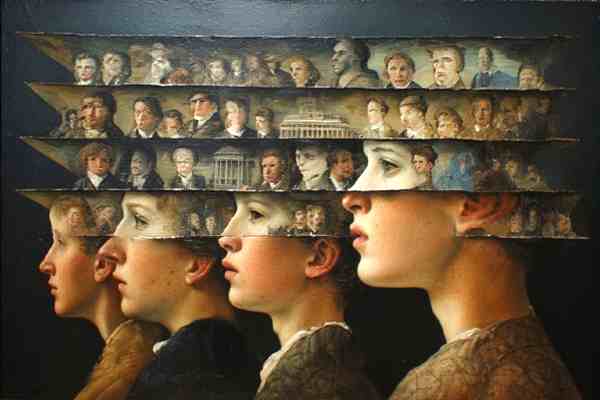
Mental conditioning and social programming shape how people think, value, and behave. It works through layers of influence and control that guide perception, belief, and action. Understanding these layers helps us take back control.
Culture develops over time through repeated exposure to ideas. Stories, leaders, and shared expectations shape perception. They install beliefs and values that feel normal and unquestioned.
When many people absorb the same patterns of thinking, those beliefs begin to guide behavior and social interaction. Over time, these shared patterns influence culture, institutions, and public life.
This is the first installment, the hub article, in a seven-part series that examines how ideas take hold in the human mind, organize into shared systems, and eventually shape culture over time. Each article explores a different stage in that process and how those stages connect. The list and description of each is at the end of this article.
Mental conditioning and social programming
The programming of our worldview starts early. Families, schools, religious groups, media, and social networks shape our ideas. They influence us as we grow up. These influences shape how we see right and wrong, truth and meaning, and our role in the world.
As these ideas take root, they begin to guide behavior. People often repeat what they learn. They may not see how much those ideas shape their thoughts. When many people think alike, their thoughts start to shape culture and public life.
Our thoughts are shaped deliberately through the reinforcement of certain ideas. Governments, institutions, and organizations often share certain stories. They do this to influence how people think and act.
Methods like propaganda and social pressure reinforce their desired thinking. Repeated messages also boost these thought patterns.
Mental conditioning happens inside the individual.
Social programming happens around the individual.
Layers of influence and control
This programming works at both the personal and social levels. It affects how individuals think while also shaping the environment they live in. It does not happen through a single event or message. It develops through repeated exposure to ideas and experiences.
These influences build on one another. Each layer strengthens the others. Over time, the combined layers shape how people interpret information, what they believe, and how they behave.
Understanding these layers shows why some ideas spread fast, while others fade away. It also helps explain why some ways of thinking stay the same over time.
Why mind control tactics are studied in pieces
Many fields study the effects of mental conditioning and social programming, but they usually examine only one aspect at a time.
Psychology studies how individuals think and form beliefs. Sociology studies how groups behave. Political science studies power and ideology. Education studies learning and socialization.
Each field explains part of the process, but the pieces are rarely connected. This continuous programming operates on multiple levels. To grasp it fully, we need to consider all these layers together.
These layers of influence and control follow a pattern. Ideas grow, stabilize, and spread through society this way.
The six layers of mental conditioning and social programming
Layer 1 — Psychological foundations
People seek meaning, belonging, identity, and certainty. These needs make individuals open to ideas that promise answers and stability.
Emotions such as fear, hope, pride, and concern about fairness can make certain ideas feel especially convincing. These emotional responses help anchor beliefs in the mind.
Layer 2 — Narrative framing
Ideas are often taught through stories. Narratives explain where people come from, what is right or wrong, and what the future might hold.
Religious teachings, political movements, and cultural traditions use stories. These stories help shape beliefs and values.
Layer 3 — Institutional reinforcement
Institutions help preserve and spread ideas. Schools, religious groups, governments, and media share ideas. They pass these ideas to the next generation.
Rituals, traditions, and authority figures reinforce these ideas and help them appear normal and stable.
Layer 4 — Social behavior
When ideas become widely shared, they begin to influence behavior across society.
These beliefs shape customs, expectations, and public policies. They can boost cooperation within groups. However, they can also cause division between groups with differing views.
Layer 5 — Adaptation and resistance
Some belief systems adapt when new information appears. Discussion, debate, and reform allow ideas to change.
Other systems resist change. When ideas become rigid, they can lead to conflict, polarization, or extreme positions.
Layer 6 — Transmission of ideas
Ideas spread through communication. In today’s world, this process works like memetic transmission. Ideas copy and spread through social networks and media. Stories, media, education, and everyday conversation carry ideas from one person to another.
Ideas that connect with emotions or identity often spread the fastest and reach the largest audiences.
Taken together, these layers create a pattern through which ideas move from the mind into culture and society.
How the layers build systems of influence
Mental conditioning and social programming rarely appear as a single idea or message. It builds step by step through a chain of influence.
The process often begins in the mind. Psychological needs such as belonging, safety, and meaning make people receptive to certain ideas.
Those ideas are then organized into narratives. Stories explain who people are, what they should believe, and who they should trust.
When narratives become widely accepted, they move into institutions. Schools, religious groups, governments, and media share the same ideas. They do this through authority, rules, and repetition.
Over time, these ideas shape social behavior. Cultural norms, laws, and traditions begin to reflect the beliefs that people share.
Once established, ideas spread through communication networks. Stories, media, and social interactions spread similar ways of thinking. They connect communities and pass ideas through generations.
This pattern can be summarized simply.
The Path of Influence
- Psychological needs shape belief.
- Beliefs form shared narratives.
- Narratives become embedded in institutions.
- Institutions influence social behavior.
- Ideas spread through communication and culture.
The health of a system of ideas
The strength of a belief system does not depend on how strongly it claims to be true.
Its health depends on whether it allows correction when it is wrong.
Healthy systems allow questioning, debate, and revision. They adjust when new information appears.
Unhealthy systems suppress doubt and punish disagreement. When correction becomes impossible, systems of influence can become rigid or extreme.
Where this pattern appears
The effects of mental conditioning and social programming are not limited to religion.
The same structure appears in many systems of ideas, including:
- nationalism
- political ideologies
- conspiracy movements
- cults
- extreme political polarization
In each case, the mechanism is the same. Psychological needs shape narratives. Narratives become institutions. Institutions influence society, and those ideas spread through communication.
How the layers work together
These layers do not operate independently. Psychological needs shape the stories people accept. Those stories are reinforced through institutions. Institutions influence social behavior and cultural expectations.
Ideas move through communication networks. They reach new communities. They also strengthen existing beliefs. Over time, the layers of influence and control work together to create stable patterns of thought and behavior.
Why mental conditioning persists
We allow this continual programming because it meets important human needs. People want identity, belonging, and explanations for the world around them.
Institutions help stabilize ideas by repeating them through education, tradition, and authority. Narratives simplify complex problems and make them easier to understand.
Modern communication systems let ideas spread fast. They reach big audiences and boost the power of shared beliefs.
The benefits and risks of mental conditioning and social programming are well known. However, the risks are often given much less weight.
Benefits
Shared patterns of thought can create cooperation and stability. They help communities organize around shared values and goals.
Cultural traditions and social norms also connect generations and provide a sense of continuity.
Risks
Distorted or harmful programming can create divisions between groups with different ideas.
Rigid systems may resist new knowledge or discourage questioning. In extreme cases, strong ideological conditioning can contribute to conflict or radical movements.
Articles in This Series
Hub Article — Mental Conditioning and Social Programming
Overview of individual and societal conditioning, which points to the detailed articles.
Article 1 — Psychological Foundations
Explores the human needs and emotions that make people open to the effects of mental and cultural conditioning.
Article 2 — Narrative Framing
Examines how stories and cultural narratives organize beliefs and values.
Article 3 — Institutional Reinforcement
Studies how institutions preserve and transmit ideas across generations.
Article 4 — Social Behavior
Looks at how shared beliefs shape cultural norms and social behavior.
Article 5 — Self-Correction Mechanism
Examines why some belief systems evolve while others become rigid.
Article 6 — Memetic Transmission
Explores how ideas spread across communities and societies.
Conclusion
Mental conditioning and social programming are perhaps the most powerful influences in human society. It shapes how people think, what they value, and how they behave.
Examining the layers of influence and control helps us see how ideas form, spread, and shape our cultures.
References
- The Cognitive Science of Belief: A Review of Heuristics, Biases and Belief Formation, Frontiers in Psychology.
- Social Influence, Stanford Encyclopedia of Philosophy.
- Propaganda, Encyclopaedia Britannica.
- Memetics, Stanford Encyclopedia of Philosophy.
- The Amygdala and Emotional Processing: Implications for Fear and Belief Formation, Dialogues in Clinical Neuroscience.
- Socialization, Encyclopaedia Britannica.
- Propaganda, Stanford Encyclopedia of Philosophy.
- Truth Decay: An Initial Exploration of the Diminishing Role of Facts in Public Life, RAND Corporation.