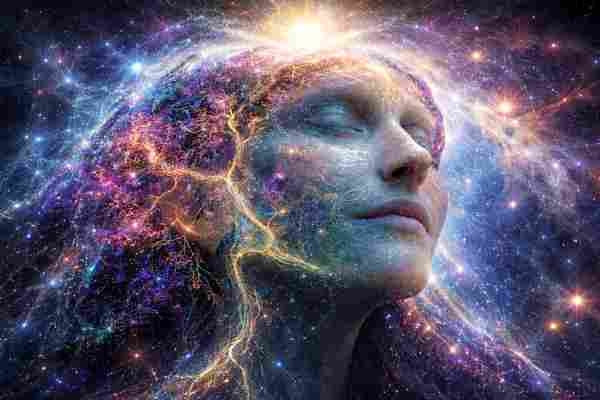
The concept of the universal, collective shared mind is the idea that our consciousness does not originate in the brain. It is one way to explore one of the hardest unanswered questions: “What is consciousness?” Contemplating the various aspects of this may not solve this question, but it will increase your own insight.
Most people are taught that the mind is private, locked inside the skull, and powered only by the brain. That view feels solid because it matches what we can measure and control.
But lived experience often points elsewhere. Shared insight, sudden knowing, and collective emotion show a greater force at play. This force connects us instead of isolating us.
The article describes altered or expanded awareness but does not ask the reader to enter one. Provides conceptual orientation before experiential or critical engagement.
The idea of a universal mind
The universal collective shard mind suggests that consciousness and awareness are not singular. We do not possess these attributes. Instead, our experience is a part of a greater shared experience. The mind does not create awareness from nothing. It receives, filters, and expresses it through biology, culture, and attention.
It does not mean everyone thinks the same thoughts. It means awareness itself is shared, while interpretation is personal.
Science has been attempting to answer the question, What is consciousness, by examining the body and the brain. This is akin to looking for the origin of the sound coming out of the radio by taking the radio apart. This approach is ill-fated.
The mind may be less like a generator and more like a receiver.
How various traditions interpret it:
- Philosophy: A single rational order or intelligence underlying reality.
- Metaphysics: A cosmic mind that expresses itself through every living thing.
- Psychology (Jungian): A collective unconscious containing universal patterns and archetypes.
- Mysticism: A shared consciousness that individuals can access through insight or contemplation.
Many people accept different aspects of these perspectives. Which of these resonates with you the most?
Waves and the ocean analogy
Think of individual minds as waves.
Think of the universal mind as the ocean.
Each wave is distinct, but all are made of the same water.
The ocean does not erase the wave. It explains it. We are like individual drops of water in the ocean.
What the universal or collective mind is not
It does not imply that personal identity is an illusion or that individuality dissolves into a featureless whole. It is not a religious doctrine, nor is it reducible to a psychological mechanism.
It’s different from the soul, seen as a personal essence. It also differs from God, often viewed as a transcendent being instead of an immanent field behind consciousness. The universal mind is a conceptual bridge—linking personal experience with a larger, shared foundation.
This is not that:
- Not the loss of individuality → but the context that makes individuality possible
- Not a personal soul → but a shared foundation of awareness
- Not a distant deity → but an immanent field
How the field behind consciousness becomes experience
The universe does not speak to us in words. It expresses through sensation, intuition, emotion, and meaning. The nervous system translates the field into usable experience.
We don’t “access” a universal mind like we access a file. Instead, people from various traditions, psychology, and philosophy describe a shift in awareness. This shift loosens the usual boundaries of the personal mind. A more global, unfragmented consciousness then becomes noticeable. The search results you triggered point to three main pathways that often appear in the literature.
- Mystics and contemplatives call this a non-dual or “unitary” state. Here, awareness feels spacious and continuous. It doesn’t belong to any specific self.
- Accounts of “cosmic consciousness” (e.g., Bucke, Masters) describe the same pattern: the sense of my mind dissolves into a larger field of knowing.
This isn’t about belief—it’s a shift in cognitive mode. Awareness moves first. Action follows.
What does this change about consciousness and awareness
If consciousness arises from a field, then awareness is not produced by effort. It is accessed through presence. Attention tunes the signal, not force.
This reframes growth and insight. Instead of building awareness, we clear the interference.
- Awareness exists before deliberate thinking
- Presence increases clarity without strain
- Connection reduces the need for control
Living from the universal mind
Living from field awareness does not require belief. It shows up as listening more deeply, reacting less quickly, and sensing context before acting.
When awareness is shared, cooperation becomes easier, and meaning feels less fragile.
What might change if you trusted awareness itself, rather than trying to manage every thought it produces?
Different languages for the same insight
Philosophy describes a rational structure behind reality. Metaphysics imagines a cosmic intelligence expressed through all forms. Psychology identifies inherited patterns that influence thought before learning begins. Mysticism speaks of a shared awareness accessible through insight or stillness. These traditions disagree on details, but they are circling the same idea. This central theme is that experience arises from a field behind consciousness and awareness.
The universal mind also connects to several other related ideas.
Proofs of the universal collective shared mind
There are no proofs in the strict sense. There are only arguments that point to its existence. Brain states and how we process information can’t fully explain “qualia.” Qualia are the personal, felt experiences.
Recent theories suggest that consciousness acts more like a field rather than a separate entity. Consciousness is continuous, foundational, and manifests as individual singularities of individual experience.
Mystical states and near-death experiences suggest we all share a universal mind. Even dreaming supports the idea that experience is not tied to the physical brain.
Major associated concepts
Similar ideas in different cultures
Many traditions speak of a shared awareness connecting all beings. This idea can be found in indigenous beliefs and philosophical idealism. It is reflected in the idea of interconnectedness. The universal mind acts as a medium for experiences to resonate among individuals. It lets meaning, empathy, and insight flow between people, even without direct communication. It serves as the connective tissue of consciousness.
People report remarkably similar experiences when the sense of self becomes permeable:
- A feeling of interconnectedness with all beings
- A perception of one underlying consciousness
- A dissolution of the boundary between observer and observed
These descriptions support the idea of a universal collective shared mind. This mind acts as a field behind consciousness and awareness, not as many separate minds.
The consistency of these reports doesn’t prove the universal mind, but they do point to it.
An archetype beneath the surface — collective unconscious
Carl Jung’s concept of the collective unconscious adds psychological depth to the discussion. Instead of a metaphysical field,
Jung talks about a common pool of archetypes. These are patterns of thought and behavior passed down through generations. It’s similar to the idea of a universal collective mind. Individual consciousness is influenced by forces greater than just personal experience. The collective unconscious becomes a psychological doorway into the universal.
Cosmic consciousness — intelligence of the universe
In mystical traditions, the universal mind is seen as cosmic consciousness. It is an intelligence that fills the universe.
Here, consciousness is not an emergent property of matter but a fundamental aspect of reality. Stars, atoms, ecosystems, and human minds all participate in the same underlying awareness. This perspective treats the universe as a living, thinking whole.
The akashic records — memory on a universal scale
Some traditions talk about the Akashic Records. This is a symbolic archive that holds all experiences, thoughts, and events. Whether taken literally or metaphorically, the idea functions as a model of universal memory. It suggests that nothing is lost; everything is preserved within the larger field of mind. In this framing, the universal collective shared mind is not only consciousness but also continuity.
The biggest issue is that “Akashic records” are defined in a way that cannot be tested, verified, or challenged.
Many spiritualists use “Akashic access” to claim special insight into:
- past lives
- cosmic laws
- other people’s destinies
- hidden truths about history or science
Because the source is supposedly cosmic and infallible, the person gains unearned authority. This is where the misuse becomes ethically dangerous: people defer to claims that have no grounding.
Confusion between metaphor and literalism
In its original context, “Akasha” was a metaphor for the subtle substrate of reality—not a cosmic filing cabinet. Modern spiritualists often literalize it into:
- a database
- a library
- a cloud server of souls
This shift encourages people to treat imaginative imagery as if it were an empirical fact. This leads to commercial exploitation, providing Akashic readings, healing sessions, and certification programs. The problem isn’t spirituality—it’s selling certainty where none exists. Most of all, it distracts from more grounded models of the universal concept of the mind.
Being and becoming — ground of existence
Philosophers often approach this concept through the lens of being and becoming. Being refers to the stable essence behind all things; becoming refers to the unfolding processes of change.
The universal mind is positioned as the ground of both consciousness and awareness. It is the stable source from which existence arises and the dynamic force through which it evolves. It is the stillness behind movement and the movement within stillness.
Unity in diversity — individuality as expression, not exception
One of the most compelling ideas associated with the universal collective shared mind is the principle of unity in diversity. Each person is distinct, yet each participates in the same underlying consciousness.
Who we are is a collection of experiences that become memories. This idea aligns with the idea that we do not cease to exist when the body dies. We live on as memories in a part of the collective universal consciousness.
This perspective reframes individuality as a mode of expression rather than a boundary. Diversity becomes the way the universal mind explores its own potential, not a fragmentation of it.
Higher or infinite intelligence — the well of insight
One point of view shared by spiritual and philosophical traditions is the concept of a unifying intelligence. The universal collective shared mind is a “morphic resonance” that orders creation. It’s a wellspring of creativity, insight, and understanding.
Individuals may access this intelligence through contemplation, intuition, or moments of sudden clarity. In this sense, the universal mind is not distant or abstract; it is the wellspring of inspiration that surfaces in everyday life.
Conclusion — a persistent idea with enduring power
The idea of a universal collective shared mind continues to exist. It provides a clear way to grasp consciousness, connection, and meaning. It combines ideas from psychology, philosophy, and spirituality. It does not merge them into one belief system.
The universal mind offers a wider perspective on consciousness. It can be seen as a metaphor, a metaphysical idea, or a psychological model. It suggests that behind every thought lies a deeper field, and behind every individual mind, a universal one.
References
- Consciousness. Stanford Encyclopedia of Philosophy.
- Panpsychism. Stanford Encyclopedia of Philosophy.
- Metaphor. Stanford Encyclopedia of Philosophy.
- Is Consciousness a Fundamental Property of the Universe? Frontiers in Psychology.
- Cosmopsychism and Consciousness Research: A Fresh View on the Causal Mechanisms Underlying Phenomenal States. Frontiers in Psychology.
- Collective Unconscious. Encyclopaedia Britannica.
- Panpsychism. Internet Encyclopedia of Philosophy.