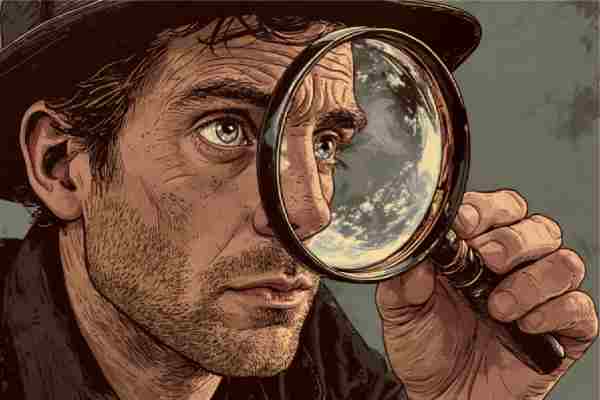
Seeking truth beyond religion often begins when beliefs no longer make sense. Living without certainty makes the individual responsible for their decisions. It begins when inherited beliefs no longer match reality.
For many people, the first cracks appear in ordinary situations. A prayer goes unanswered. A moral rule feels wrong when applied to a real person. A question is silenced instead of addressed. These moments create discomfort not because truth is lost, but because certainty is.
This article explores what happens after religious certainty fades. It looks at how people seek truth without certainty. It explores how meaning, responsibility, and growth emerge when authority stops giving answers that align with reality.
Inner Work Gate;
This article explores what happens internally when certainty dissolves—how people relate to not-knowing, meaning, and decision-making without absolute answers.t may increase discomfort before clarity as unresolved material surfaces. Emotional stability should be established before engaging deeply with this process.
It does not analyze institutions, systems, or external power structures.
This article is part of a six-piece series examining truth, belief, and outcomes across systems and personal experience.
Recommended order:
1. What is True: Weighing Truth by Faith and Truth By Fact (Definition / Keystone)
2. How Faith Operates as Truth — When Belief Mimics Facts (Mechanism)
3. Seeking Truth Beyond Religion: Living Without Certainty (Inner Work Application)
4. Exploring The Impact of Evidence-Driven Decisions for Humanity (Collective Application)
5. The Social Cost and Systemic Harm of Organized Religion (Systemic Consequence)
6. What You Face When You Leave a Religion (Personal Outcome)
Seeking Truth Beyond Religion
Uncertainty can be scary or motivating. Not knowing what’s around the corner makes us curious and cautious. We naturally seek answers beyond the unknown, thereby entering uncertainty.
Living Without Certainty
Living with religious certainty often involves an exchange. In return for clear answers, structure, and reassurance, personal judgment is surrendered. Obedience replaces autonomy, and freedom is narrowed to what authority permits.
Consider someone raised to believe that moral certainty comes from submission to religious rules. Decisions about sexuality, relationships, or career are framed as tests of obedience. Doubt is discouraged, not because questions lack merit, but because certainty depends on compliance. Structure is maintained by discouraging deviation.
- Certainty is offered as reassurance
- Obedience becomes the condition
- Responsibility is deferred to the authority
When certainty is lost, that structure disappears. The loss can feel like freedom taken away rather than regained, because rules once absorbed responsibility. Living without certainty means accepting that no authority will decide what is right. Freedom returns, but so does accountability.
When certainty depends on obedience, what is actually being protected—truth or control?
Replacing Obedience with Responsibility
Religious morality often simplifies decisions by framing them as obedience. Rules define what is permitted, forbidden, or required, and moral confidence comes from following them correctly. Responsibility is largely externalized. If the rule was followed, the action is considered justified.
Actions become visible in moments where rules conflict with experience. Consider a parent deciding how to respond to a child who comes out as gay. Religious teaching may define the behavior as sinful, while empathy and care point in a different direction. Obedience resolves the conflict quickly. The rule is applied, and the moral burden is shifted onto authority.
Outside religion, that shortcut disappears. There is no rule that ends the question. Responsibility moves back to the individual, who must weigh harm, care, consequences, and context. The decision cannot be justified by compliance alone.
This shift is uncomfortable because it removes moral absolutes. But it also restores agency. Responsibility becomes something that must be practiced rather than obeyed, and ethics become responsive to real people rather than fixed commands.
When no authority decides what is right, how do we learn to assume responsibility while living without certainty?
Building a Personal Framework for Meaning
After religion, meaning is no longer inherited. It has to be assembled.
Consider someone who once believed their purpose was assigned by God: serve the faith, follow the rules, and prepare for an afterlife. When that belief ends, the question “What am I here for?” no longer has a predetermined answer. There is no replacement doctrine waiting.
What replaces it is choice. Values are selected rather than received. Some people prioritize honesty after years of enforced conformity. Others focus on care, creativity, learning, or contribution. Meaning grows from what a person decides to invest in, not from what they are told matters.
This framework is flexible by design. It changes as understanding grows and circumstances shift. There is no final version to defend, only a working structure that can be revised.
If meaning is something we build rather than inherit, what do we choose to build it from?
Truth-Seeking as a Lifelong Practice
If you notice yourself shifting into arguments about whether religion or evidence is “right,” that is a Regulation response. This section stays with internal experience and adaptation.
Religious certainty trains people to treat truth as settled early and defended forever.
“Once you know the truth, the work is finished.”
Outside religion, that assumption collapses.
Truth is no longer something you arrive at and protect. It becomes something provisional, revised as understanding improves. The goal shifts from being right to becoming less wrong.
What changes is not curiosity, but permission.
- Beliefs can be updated without shame
- Questions do not signal failure
- Correction becomes progress
This way of seeking truth beyond religion shows up quietly. A person changes their mind after reading new evidence. An explanation is dropped because it no longer fits reality. Living without certainty is replaced with honesty about what is known and what is not.
Truth-seeking becomes a practice rather than a position. It continues precisely because it never claims to be finished.
If truth must be defended to survive, was it ever truth—or just certainty?
Critical Thinking as a Daily Skill
Critical thinking is not an abstract discipline. It is at the core of seeking truth beyond religion. It shows up in small, ordinary moments where claims compete for attention.
A headline promises certainty.
A charismatic speaker offers simple explanations.
An argument appeals to fear, identity, or belonging.
Instead of asking “Who said this?” the question becomes “How do they know?”
Critical thinking does not demand cynicism. It demands a pause. Claims are examined for evidence, sources are separated from conclusions, and emotional reactions are recognized before agreement is given.
This skill becomes practical quickly. It helps distinguish persuasion from explanation, confidence from credibility, and sincerity from accuracy. Over time, it creates distance between identity and belief, making it easier to change one without losing the other.
Critical thinking is not about winning arguments. It is about avoiding unnecessary mistakes.
If belief no longer defines identity, what changes about how claims are evaluated?
Spirituality Without Supernatural Belief
As an example, a person sits quietly each morning, not to pray, but to notice their breath. No request is being made, no listener is assumed, and no outcome is promised. The practice is simple: attention to experience as it is.
For many who leave religion, this kind of practice replaces what prayer once provided. Not answers, but awareness. Not reassurance, but grounding. The value comes from the effect on the mind and body, not from belief in an unseen force.
Meditation, reflection, journaling, and therapy offer tools for understanding internal states without attributing them to divine influence. Emotions are examined rather than interpreted as messages. Fear is understood as a psychological response rather than a spiritual failure.
This form of spirituality is independent of belief. It focuses on experience, self-regulation, and understanding. Meaning is found in presence and insight rather than in submission to myth or doctrine.
If inner life can be explored without supernatural explanations, what role does belief actually play?
Community Without Creed
Religion often answers the question of belonging before it is asked.
“Believe this.”
“Agree with that.”
“You are one of us.”
When belief is removed, community does not vanish—but the automatic rules do.
Without a creed, belonging becomes conditional in a different way. People gather because something is shared in practice rather than asserted in belief. Support is offered without doctrinal agreement. Disagreement does not automatically signal threat.
What replaces creed is negotiation.
- Shared values instead of shared doctrine
- Consent instead of obligation
- Boundaries instead of conformity
This kind of community is less rigid and more fragile. It requires communication rather than enforcement. It survives not because everyone agrees, but because participation remains voluntary and meaningful.
If belief is no longer the price of belonging, what actually keeps people together?
Engaging a Religious World Without Hostility
Living beyond religion does not remove the need to interact with people who still hold religious beliefs. Family members, coworkers, neighbors, and friends may continue to frame truth, morality, and meaning through faith. The challenge is not disagreement itself, but how that disagreement is handled.
For many people leaving religion, early interactions are marked by frustration or defensiveness. Beliefs once shared now feel imposed. Conversations can quickly turn into arguments, not because truth is being discussed, but because identity is felt to be threatened on both sides.
- Belief is often tied to identity
- Challenges can feel personal rather than intellectual
- Silence can sometimes be self-protection
Engaging without hostility means choosing boundaries intentionally. Curiosity can replace contempt, but disengagement is sometimes healthier than debate. Not every claim needs to be challenged, and not every conversation needs to continue. Respect does not require agreement, and distance does not require rejection.
When disagreement is unavoidable, how do we decide whether engagement serves understanding or simply drains it?
An Open-Ended Journey
Seeking truth beyond religion does not end with replacement answers. It ends with a change in posture.
There is no final certainty to arrive at. No system to inherit. No authority to resolve every question. What remains is the willingness to keep looking, to revise, and to live honestly with what is known and unknown.
Living without certainty does not mean living without direction. It means accepting that growth continues without guarantees. Meaning is built, responsibility is owned, and understanding deepens through experience rather than submission.
The journey does not close here. It stays open by design.
If certainty is no longer the goal, what does a life committed to seeking truth beyond religion look like over time?
References
- The cognitive psychology of belief and disbelief. Behavioral and Brain Sciences.
- Confirmation bias: A ubiquitous phenomenon in many guises. Review of General Psychology.
- Metacognition: Monitoring and control of cognition. Trends in Cognitive Sciences.
- Mindfulness practice leads to increases in regional brain gray matter density. Psychiatry Research: Neuroimaging.
- Motivated reasoning and belief formation. Current Directions in Psychological Science.
- Meditation and attention regulation: Neuropsychological mechanisms. Frontiers in Psychology.