
What you focus on shapes how you think. How you think shapes how you live. Across cultures, two opposing patterns emerge—one grounded in balance and proportion, the other driven by chaos and clutter. These patterns quietly shape behavior, values, and the direction of society.
This article examines how different ways of thinking organize the mind. It is not about geography or identity. It concerns internal structure—how beliefs, habits, and values organize themselves and influence perception.
Each section builds step by step. We move from basic perception to thinking patterns, then outward to culture and policy. The goal is clarity: to show how balance produces coherence, and how imbalance creates distortion.
Inner Work Gate:
This article examines belief structures, internal organization, and psychological patterns. It may challenge existing assumptions and increase discomfort before clarity develops. Emotional stability and basic regulation skills should be established first.
Eastern Versus Western Mindset
What we think and repeatedly focus on shapes the psychic structure of the mind. Certain patterns create balance and proportion, while others produce chaos and clutter. It is described as a conflict between harmony and fragmentation.
In everyday life, these two orientations are evident. The Eastern mindset emphasizes balance, proportion, and integration. Whereas the Western lacks a unifying philosophy, allowing competing forces to create chaos within the mind. This difference directly affects behavior, values, and decision-making.
We are not referring to geography. We describe the underlying philosophies that shape patterns of thought. These philosophies influence how the mind organizes information and assigns value.
- Proportion and balance create internal harmony and clarity.
- Chaos and clutter emerge when mental resources compete for control.
- The Eastern versus Western mindset reflects how thinking is organized.
Balance and Proportion Versus Chaos and Clutter
Proper proportions lead to balanced symmetry. This intuitive formula is a natural part of how we perceive the world. We constantly assess symmetry, contrast, and relationship without conscious effort. This ability helps us recognize what is stable, functional, and healthy.
Proportion allows us to see differences clearly. We can distinguish subtle variations in color, sound, and shape because the mind compares values with one another. Balanced perception depends on accurate proportion, not extremes.
Balance and proportion appear everywhere humans create meaning. They guide painting, sculpture, architecture, and music. These principles form a blueprint for what we find appealing and trustworthy. When proportion is lost, the result feels chaotic and unsettling.
The Eastern versus Western mindset reflects how these perceptual skills are applied to thinking. The Eastern mindset preserves the appropriate proportions for balancing mental resources. The mindset of Western thought often fragments perception, favoring excess, conflict, and distortion. This contrast between balance and proportion versus chaos sets the stage for how the mind organizes itself.
Imbalance does not announce itself as chaos. It disguises itself as certainty.
Balanced Thinking as a Cognitive Skill
Balanced thinking is a learned skill. It is the ability to weigh differences accurately and hold multiple points of view without distortion. This skill enables the mind to compare information in proportion rather than reacting to extremes.
When thinking is balanced, the mind can process a wide range of data and reach coherent conclusions. This supports clear judgment, creativity, and problem-solving. Balance and proportion create mental stability and emotional regulation.
Chaotic thinking works differently. Information competes instead of cooperating. Attention fragments, priorities shift constantly, and conclusions become inconsistent. This internal chaos contributes to anxiety, short attention spans, and distorted reasoning.
The Eastern versus Western mindset highlights this contrast. The Eastern point of view cultivates the ideal proportions of mental resources for balanced analytical and intuitive thinking. The Western point of view often rewards speed, impulse, and dominance, increasing chaos and clutter within the mind. Over time, these patterns shape behavior and mental health.
The Seven Elements of the Mind
To understand balance and proportion versus chaos, we need a clear structure. Both the Eastern versus Western mindset operate using the same internal elements. The difference is not what exists in the mind, but how those elements are organized.
- Body
- Culture
- Heart
- Instincts
- Personality
- Inner Critic
- Thinking
The mind contains seven primary elements: the body, culture, heart, instincts, personality, inner critic, and thinking. Every person has all seven. No element is good or bad on its own. Problems arise when one element dominates or suppresses the others.
The correct proporation allow each element to perform its proper function. When aligned, these elements support one another and create coherent thinking. When they compete for control, chaos and clutter emerge inside the mind.
The Eastern versus Western mindset becomes visible in how these elements are arranged. The Eastern emphasizes balance and integration. The Western often produces imbalance, allowing culture, instinct, or ego to override clarity and proportion. This structural difference shapes perception, behavior, and values.
Understanding mental structure is the first step. Developing the ability to observe thoughts, emotions, and internal impulses without becoming identified with them is what allows balance to emerge in practice.
For a deeper exploration of this capacity, see:
→ Quantum Attention Training, Meta-Awareness and the Inner Observer
Quality: Accuracy and Efficiency
Quality is a measure of how accurately and efficiently the mind processes information. When thinking has quality, it produces reliable conclusions using the least amount of distortion. Balance and proportion are required for quality thinking to function.
A simple way to understand quality is through logic. When basic premises are accurate, conclusions remain stable. When premises are false or contradictory, the mind must compensate, creating confusion and mental clutter. Over time, this degrades clarity.
The Eastern versus Western mindset differs sharply here. The Eastern values coherence, testing ideas through experience and reflection. This preserves quality and proportion within thinking. The Western often accepts inherited beliefs without examination, allowing contradictions to coexist.
When inaccurate beliefs are repeated, they reshape the psychic structure of the mind. This lowers quality and increases susceptibility to manipulation. Balance and proportion versus chaos are not abstract ideas—they determine whether thinking remains clear or becomes distorted.
The Eastern Mindset: Integration and Inner Work
The Eastern mindset is organized around achieving symmetry. Each element of the mind is given space to function without overpowering the others. The heart serves as a stabilizing center, helping integrate thinking, instinct, and emotion.
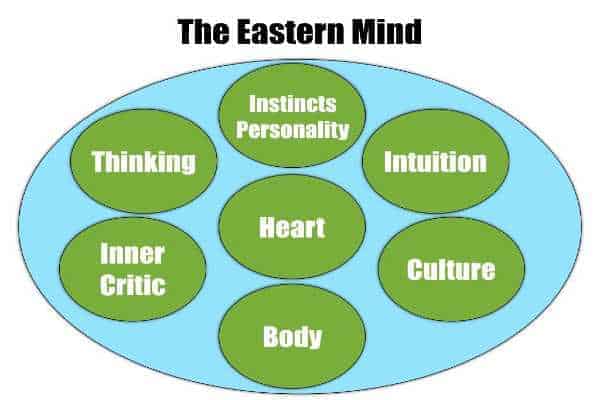
Inner work is central to maintaining this balance. Practices such as meditation increase awareness and help separate internal resources into their proper roles. This reduces internal conflict and restores proportion within the psychic structure.
When the mind is balanced, thinking becomes clearer and more grounded. Emotional reactions soften, and the individual becomes less vulnerable to psychological manipulation. Balance and proportion create resilience against harmful cultural programming.
The differences between the two mindsets are visible in behavior. Those aligned with the Eastern tend to value compassion, cooperation, and responsibility toward others and the environment. These qualities emerge naturally when the mind operates in balance rather than chaos.
- Reduced susceptibility to manipulation.
- Clear separation of emotion and reasoning.
- Greater internal stability.
The Western Mindset: Imbalance and Cultural Override
Western thinking, values, and beliefs are defined by imbalance and internal competition. Instead of balance and proportion, different elements of the mind struggle for dominance. Culture, instinct, and personality often overpower the heart and critical thinking.
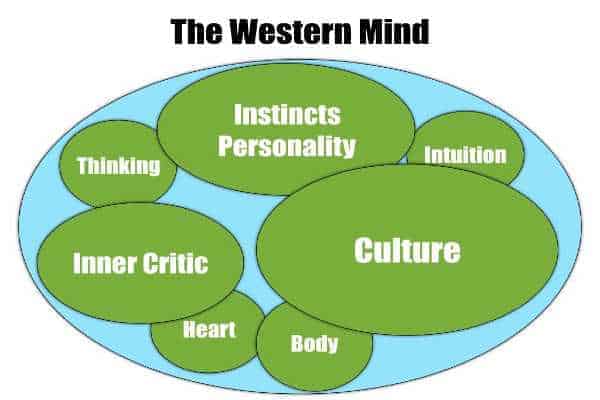
This imbalance produces chaotic and cluttered thinking. To resolve internal conflict, the mind creates justifications for greed, bias, superiority, and discrimination. These distortions seem rational from within, even when they contradict reality.
Cultural narratives play a dominant role in Western thinking. Repeated messages from religion, politics, and commercialism install scripts that override internal values. Advertising exploits fear and insecurity, reinforcing psychological chaos.
The Eastern versus Western mindset becomes clear here. Eastern thinking naturally resists manipulation through balance and proportion. But Western thinking becomes increasingly susceptible. When culture controls the mind, balance is lost, and chaos becomes the norm.
- Increased internal conflict.
- Reliance on external authority.
- Normalization of distorted thinking.
Myth, Literalism, and Cognitive Distortion
Myth has always been used to communicate ideas about human nature. In the Eastern mindset, myths are treated as metaphors. They point inward, using stories to describe psychological processes rather than literal events or beings.
The Western mindset often treats myth as fact. Symbolic stories become historical claims and moral absolutes. When myths are taken literally, contradictions appear and must be defended rather than examined. This creates mental clutter.
To manage these contradictions, the mind learns selective thinking. Certain parts of a story are emphasized while others are ignored. Questioning is discouraged, and obedience replaces inquiry. Over time, this weakens balanced thinking.
This difference highlights balance and proportion versus chaos. The Eastern philosophy uses myth to clarify inner structure. Western theology uses literal belief to enforce external control. The result is cognitive distortion that becomes normalized through culture and tradition.
Societal Consequences: Policy, Power, and Disparate Treatment
The Eastern versus Western mindset does not stop at the individual level. When distorted thinking becomes widespread, it scales into institutions, laws, and public policy. The internal structure of the mind is reflected outward in how societies function.
Imbalance shows up as disparate treatment. When resources flow upward, they are referred to as incentives, tax breaks, or stimulus. When resources are needed by the vulnerable, they are labeled as costs, entitlements, or burdens. This language reflects chaos rather than proportion.
The conflict between balance and proportion versus chaos is especially visible in the tension between science and religious authority. When belief overrides evidence, policy becomes disconnected from reality. Decisions are made to preserve power rather than serve the public.
When distorted thinking captures government, the consequences multiply. Inequity increases, trust erodes, and resources are misallocated. The Eastern versus Western mindset becomes a collective problem, shaping not just individual lives but the future of society itself.
Distorted thinking always scales upward.
Conclusion: Choosing Balance Over Chaos
The battle of mindsets represents an ongoing struggle between balance and proportion on the one hand, and chaos and clutter on the other. This conflict plays out inside the mind before it appears in behavior, culture, and policy. What we believe quietly shapes how we think and act.
Proportion and balance are not abstract ideals. They are practical skills that can be learned and strengthened through awareness and inner work. When the mind is organized, thinking becomes clearer and more ethical.
Chaos thrives when beliefs go unexamined and cultural scripts replace independent thought. Balance restores clarity by placing each mental element in its proper role. This is why what you believe matters.
Recognizing imbalance does not automatically resolve it. Repair requires working directly with entrenched beliefs and clarifying values so they align with lived experience rather than inherited scripts.
For structured approaches to repairing harmful belief patterns and integrating healthier values, see:
→ The Core Process For Repairing Harmful Thinking, Beliefs, and Values
→ Aligning Beliefs with Truth — Objective Truth Versus Subjective Truth
The future depends on which mindset we cultivate. Choosing balance and proportion over chaos is not just a personal decision. It is a responsibility to ourselves, to others, and to the world we shape together.
References
- Facial Attractiveness and Symmetry. Trends in Cognitive Sciences.
- The Evolutionary Psychology of Physical Attractiveness. Philosophical Transactions of the Royal Society B.
- Symmetry and Human Facial Attractiveness. Proceedings of the Royal Society B.
- Beauty. Stanford Encyclopedia of Philosophy.
- Golden Ratio. Encyclopaedia Britannica.
- Psychoanalysis. Stanford Encyclopedia of Philosophy.