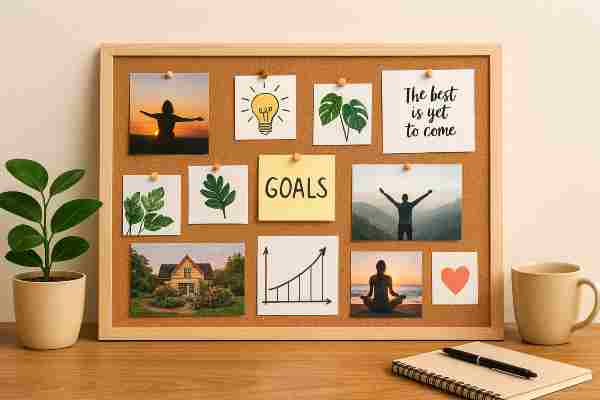
They say seeing is believing, and there is a reason that phrase has lasted so long. When we can actually see something, it feels more real. Learning how to create a vision board turns vague hopes into a motivational tool.
We all have dreams and goals. They give us something to look forward to and something to aim for. For many, those dreams feel out of reach. It’s not due to a lack of ability. Instead, goals fade into the background of daily life.
What we need is a tool to help us align actions with these goals over the long term. A vision board brings those goals back into focus. It gives your mind a clear picture of what you want. It gently reminds us to align behaviors to reach the goal.
Inner Work Gate:
This practice works with beliefs, self-talk, and emotional motivation. It may increase discomfort or resistance before resolution. Emotional stability should be established first.
The Power of a Vision Board and How It Works
The purpose of visualizing your goals is simple, but powerful. It keeps your ultimate goals in mind often enough that they matter daily.
Your brain is constantly deciding what deserves attention. It does this automatically. If your goals are rarely seen or thought about, your brain assumes they are not important right now.
Visualizing your goals changes that message.
When you repeatedly see images of your goals, your mind starts to view them as important. They move up the priority list. This occurs with responsibilities and issues that are often noticed.
The Psychological Framework Behind Vision Boards
These artistic representations align with how the mind already operates. The brain constantly filters information. It decides what to focus on and what to ignore.
When goals are invisible, the brain treats them as unimportant. When they are visible and emotionally meaningful, the brain tags them as relevant.
Visualizing Your Goals as a Mental Rehearsal
Visualization is not just imagining a picture. It is mentally experiencing an outcome. When you clearly imagine success, your brain activates patterns similar to those during real action.
A vision board supports this process by providing your imagination with a specific focus. Instead of vague wishes, you see details. Details make the future feel more familiar, and familiarity reduces fear.
Most goal-setting methods rely heavily on memory and motivation. We write down goals, feel inspired briefly, and then return to our normal routines. Before long, the goals we cared about sit untouched in a notebook or document.
Vision boards work differently. It does not ask you to remember your goals. It places them in front of you. When something stays in your visual field, it stays in your awareness. And what stays in your awareness quietly influences your thoughts and choices.
This is one of the biggest advantages of using them. It works even when motivation runs low, because it does not depend on willpower alone.
Creative visualization may be described as an extended meditation session reaching beyond passive contemplation and achieves transformative action. — Aberjhani
Emotion, Belief, and Self-Confidence
Vision boards also strengthen belief. By visualizing your goals regularly, they stop feeling unrealistic. They begin to feel expected.
This matters because doubt often comes from constantly picturing failure. The picture of the ideal goal gently replaces that habit with a different mental image. Over time, self-talk shifts from “this probably won’t work” to “this is something I’m moving toward.”
Identity and Attention
What you focus on shapes who you become. When your attention is repeatedly drawn to growth, stability, or progress, your identity begins to shift.
You start acting like someone who is building a future, not just reacting to the present. This identity change is gradual. When you learn how to create a vision board, you are creating a tool of change. It’s one of the most overlooked aspects of visionary transformation.
Long-Term Effects
The benefits of vision reflection rarely show up as sudden breakthroughs. They appear as steady changes in how you think and act.
Clarity improves first. When your goals are clear, mental clutter decreases. You spend less time second-guessing yourself and more time acting with purpose. Focus follows clarity. Decisions become easier because they are no longer isolated. They are connected to a larger picture.
Confidence grows as progress becomes familiar. Seeing your goals regularly makes success feel less intimidating and more normal.
Resilience strengthens as well. When setbacks happen, your larger vision stays intact, helping you recover faster.
These benefits tend to show up as:
- Clearer priorities during busy or stressful periods
- Stronger focus when making everyday decisions
- Greater confidence is built through familiarity
- More resilience when progress slows
- A steady sense of direction instead of drifting
The bottom line is that vision boards help us focus our intent on reaching goals. Keeping our goals in mind boosts clarity and self-confidence. This helps us move forward, even when we face obstacles.
Metaphysical and Spiritual Reframing
These concepts of visualization and visionary boards have been adopted by spiritualists. They have been rebranded and given metaphysical language to create marketable products. The Secret” illustrates how the law of attraction is marketed. Abundance, material wealth, and health are ripe for capitalization.
How to Create a Vision Board That Actually Works
Step One: Establish Clear Goals
Start by deciding what you want your life to look like and how you want it to feel. This step is more important than it seems. Many people feel stuck because their goals are too vague. When a goal is unclear, the mind does not know what to focus on.
Try to be specific and honest. Instead of saying, “I want to be happier,” think about what happiness looks like in daily life. Maybe it means less stress, more time, better health, or work that feels meaningful.
How and why this works:
The brain works best with clear ideas. When a goal is specific, your mind can identify the resources that support it. Vague goals are easy to forget. Clear goals give your attention something solid to work with.
Success isn’t something you have; it’s something you do. Don’t be fooled into taking shortcuts; they always lead to a dead end. Instead, establish a goal, make a plan, and take purposeful action. Those who experience success are those who live it; those who earn it. — Steve Maraboli
Step Two: Choose Images That Match the Goal
Once you know what you want, choose images that closely show it. The image should look like the goal, not just hint at it. The closer the image matches your goal, the stronger the effect.
For example, if you want a calmer home life, choose an image of a peaceful space. If you want a specific type of work or lifestyle, choose images that depict real situations, not just symbols or words.
How and why this works:
The brain responds faster to images than to words. Images are easier to remember. When an image clearly matches a goal, the brain understands what you are aiming for without confusion.
Step Three: Build Emotional Connection
Pay attention to how each image makes you feel. This step matters a lot. If an image does not elicit a positive response, it will not hold your attention.
A strong image should evoke an immediate response. It might bring hope, calm, excitement, relief, or confidence. If an image feels stressful, flat, or forced, it does not belong on your board.
How and why this works:
Emotion helps memory. The brain remembers things better when feelings are involved. When an image evokes a positive feeling, your mind naturally returns to it. This keeps the visionary reflection working over time.
Step Four: Decide on the Right Format
There is no single right way to make a visual representation of an objective. Some people prefer physical boards that they can touch and move. Others prefer digital boards, phone screens, or journals.
When you decide how to create a vision board, choose a format that fits your life. If you are on your phone frequently, a digital board may be the best option. If you like writing or journaling, a notebook may feel more natural.
How and why this works:
It only works if you use it. The brain responds to repetition. The right format is the one you will actually look at and engage with regularly.
Step Five: Place It Where You Will See It Often
A vision board does nothing if it is hidden away. It needs to be placed where you will see it naturally during the day.
This could be your bedroom, your desk, your planner, or your phone screen. The goal is not constant attention, but regular exposure.
How and why this works:
What you see often stays active in your mind. When your goals are visible, your brain treats them as important. This keeps them from fading into the background of daily life.
Step Six: Review It Consistently
Take a moment to review your vision board regularly. This does not need to be long. Even a minute or two is enough.
When you look at it, simply notice the images and remember what they mean to you. You do not need to force anything or overthink it.
How and why this works:
Repetition builds familiarity. Each time you look at your board, the connection between the image and the goal becomes stronger. Goals that feel familiar feel easier to reach.
Step Seven: Support It With Action
A vision board helps guide you, but it does not do the work for you. It works best when you take small actions that match what you see on the board.
These actions do not have to be big. They might include making better choices, setting boundaries, learning something new, or noticing chances that support your goals.
How and why this works:
A focal point for creative visualization gives us direction. Action creates progress. When the two work together, momentum builds. The board reminds you where you are going, and action helps you get there.
Final thoughts
A vision board works because it keeps your future present. By combining attention, emotion, and repetition, it helps your mind stay aligned with what you are building. When paired with honest effort and patience, it becomes a practical tool for turning intention into progress.
References
- Mindfulness Practice Leads to Increases in Regional Brain Gray Matter Density. Psychiatry Research: Neuroimaging.
- Mental Imagery and Its Role in Goal Achievement. Frontiers in Psychology.
- Cognitive Reappraisal and Emotion Regulation Flexibility. Emotion Review.
- Emotion Regulation: Conceptual and Clinical Issues. Nature Reviews Neuroscience.
- The Long-Term Impact of Stress and Trauma on Mental Health. World Psychiatry.
- Self-Affirmation and the Neural Basis of Self-Related Processing. Social Cognitive and Affective Neuroscience.