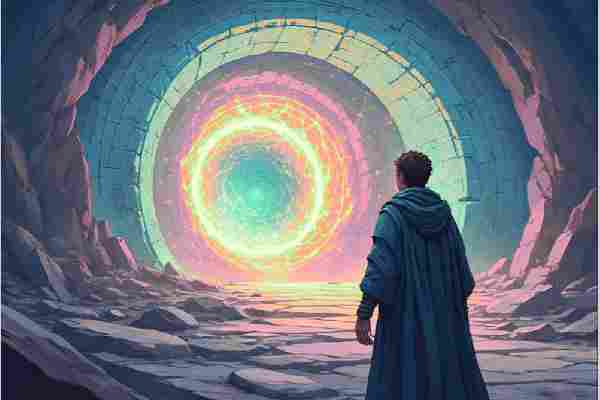
Exploring the portals of experience beyond time and space seems mystical or esoteric. But when you strip away the mythology, these portals are methods which interrupt conditioned perception. They disrupt the default settings that culture, institutions, and authority figures install in us.
Sadly, many people live inside a mental box they never chose. But every so often, something cracks the walls — a dream, a moment of stillness, a sudden insight — and the world feels bigger. These moments are portals. They reveal that our limits are learned, not fixed.
Some people sense something beyond their cultural routines. They feel the weight of old conditioning, but also a pull toward something deeper. It’s a quiet awareness that doesn’t fit the boundaries they inherited. This article explores practices that act as “portals.” These practices help loosen those boundaries and open the mind to other frames of reality.
A portal is any practice that breaks the spell of conditioning and gives you direct access to your own mind. Exploring these portals involves critical inquiry of beliefs. So, metacognition and stability are required to achieve maximum results.
The First Cracks In the Box
These portals aren’t escapes from life. There are ways of entering life more fully. They disrupt automatic patterns, enhance perception, and aid in restoring autonomy from the inside. They show that the mind is not a cage but a landscape — one with far more depth than most people ever explore.
Conditioning works silently. It shapes reactions, beliefs, and expectations long before they reach conscious thought. Over time, this conditioning becomes the invisible frame around daily life. It decides what feels possible, what feels safe, and what feels off‑limits. Most people don’t notice the frame because they’ve lived inside it for so long. It becomes the background structure that defines what “normal” feels like.
But the mind has a way of slipping past its own walls. A strange dream, a moment of deep presence, a sudden shift in perspective. The portals of experience beyond time and space reveal that the frame of reality we have been conditioned to believe is not as solid as it seems. They show that awareness can stretch beyond the familiar. They show that the mind is not limited to the patterns it learned.
Portals begin with these cracks. They begin with the moments when the mind steps outside its usual rhythm and glimpses something larger. These moments don’t need to be dramatic. They only need to be noticed. The act of noticing thoughts is meta-cognition.
The Meaning of “Experience Beyond Time and Space”
The phrase sounds mystical, but its meaning is simple: it refers to experiences that step outside the limits we were taught. It means time feels flexible. Identity feels open. Awareness feels larger. Perception feels layered. The world feels bigger.
These experiences don’t remove a person from reality. They reveal more of it. The mind is not limited to the clock or the calendar. It’s not limited to the body. It’s not limited to the stories it inherited. “Beyond time and space” simply means beyond the usual frame.
Portals show that the mind can stretch. It can explore. It can shift perspectives. It can move through layers of meaning. It can experience reality in ways that don’t fit the narrow definitions we were given.
This expansion doesn’t require belief. It requires attention. It requires curiosity. It requires the willingness to step outside the familiar.
How The Mind Is Beyond Time
Time is one of the strongest forms of conditioning. People treat it as fixed, linear, and absolute. But portals reveal that time is experienced, not imposed. It stretches in moments of awe. It collapses in moments of flow. It slows during danger. It disappears in deep meditation.
For help overcoming the common issues with meditation:
➡ Meditation Troubleshooting Guide: When the Mind Acts Like a Wild Horse →
These shifts show that time is not a rigid container. It’s a perception. And when perception changes, time changes with it.
This doesn’t mean time stops being real. It means the mind is not limited to the clock. It means awareness can step outside the usual rhythm and experience time in new ways.
This flexibility opens new possibilities. It shows that the mind is not bound to the world’s pace. It can slow down. It can expand. It can rest.
How The Mind Is Beyond Space
Space is another form of conditioning. People treat it as a boundary — a limit that defines where they are and where they are not. But portals reveal that awareness is not confined to physical location.
Dreams move through landscapes without distance. Imagination travels without effort. Memory collapses space. Empathy bridges it. Deep presence dissolves it.
These experiences don’t deny physical space. They reveal that awareness is not limited to it. They show that the mind can stretch beyond the body, beyond the room, beyond the familiar.
This expansion changes how people relate to the world. It creates a sense of openness. It creates a sense of connection. It creates a sense of possibility.
The Portals of Experience Beyond Time and Space
These are tools and experiences that are outside of social conditioning. They are shifts in perception that allow glimpses of non-ordinary reality.
Note: These experiences are best understood as perceptual phenomena, not evidence claims. Some examples are historically controversial and scientifically disputed.
Here are some practices people use to expand perception, awareness, and consciousness.
Astral Projection. Reported experiences in which people perceive a sense of separation from bodily awareness or imagine movement through symbolic environments. The Aboriginal Australian Dreamtime is an example.
Time Dilation. Time doesn’t always feel the same. During trauma or deep focus, moments can seem to slow down or speed up. What feels like minutes may actually be hours. This shows how our minds can stretch or shrink our sense of time.
Remote Viewing. A historically studied practice involving attempts to imagine or describe distant locations under controlled conditions, with disputed results. Governments studied this in the mid‑20th century, and some of the research remains classified.
Quantum Jumping. This is a modern metaphorical practice that borrows language from quantum theory to describe imaginative perspective-shifting experiences. It resembles the Shamanic journeys described in the Aboriginal Dreamtime.
Lucid Dreaming. This is when you know you’re dreaming and can control the dream. It lets you explore new worlds, meet historical figures, and expand your awareness in a safe, natural way.
Retrocausality. Some believe—outside mainstream scientific models—that the mind can influence the past through focused intention…
Sacred Geometry. Certain geometric shapes are believed to hold universal wisdom. By studying them, some people feel they can access hidden knowledge. These ideas appear in Hermetic writings, which explore how to reach realms beyond normal space and time. Even so, the first steps are grounded in logic, analysis, and critical thinking. Growth comes from stretching your limits.
DMT Journeying. DMT is a natural compound. It produces an intense altered state, often described subjectively as immersive or ‘otherworldly.’ Some users report experiences they interpret as entering another dimension.
Hypnotherapy and Past Life Regression. This technique uses hypnosis to explore memories that some believe come from past lives. Supporters say it offers insight into your larger spiritual journey.
Meditation. Practices like Japa or Transcendental Meditation help the mind enter a quiet, transcendent state. This opens the door to higher awareness and other altered states of consciousness.
Automatic Writing. This involves writing without conscious control to access the subconscious. Early psychologists and ancient mystics used it to break past mental limits.
Mnemonic Memory Techniques. These tools strengthen memory by using patterns, images, and “memory palaces.” They help you expand your mental capacity in practical, everyday ways.
These tools challenge our usual ideas about space, time, and consciousness. Whether you see them as spiritual, scientific, or simply interesting, they remind us that reality is bigger than it seems. With curiosity and an open mind, you can explore deeper layers of your own awareness.
When Awareness Interrupts Habit
Every portal has one thing in common: it interrupts the automatic flow of thought. Meditation slows the mind enough for patterns to become visible. Lucid dreaming reveals how flexible perception can be. Deep imagination opens symbolic layers that daily life hides. Hypnagogic states blur the line between waking and dreaming. Automatic writing bypasses the conscious filter and lets the subconscious speak.
Each of these practices creates a pause — a gap where the mind stops running on habit and begins to reveal itself. In that gap, thoughts lose their authority. Emotions become signals instead of commands. Identity loosens. The world feels less rigid.
This is the beginning of freedom. Not the loud kind, but the quiet kind — the kind that comes from seeing the machinery of the mind instead of being driven by it. You see, everything we “think” about reality is really an individually constructed fabrication of the mind.
The Mind as a Constructed Reality
One of the most important things portals reveal is that perception is constructed. The mind filters, shapes, and interprets everything it encounters. Most people never see this process because they’re inside it. Portals let them step outside it long enough to notice what’s happening.
Meditation shows that thoughts rise and fall on their own. Lucid dreaming shows that the mind can build entire worlds. Time dilation shows that time is flexible, not fixed. Symbolic imagination shows that meaning has layers. Automatic writing shows that the subconscious holds its own voice.
These experiences don’t replace reality — they deepen it. They show that perception is not a single, solid thing. It’s a process. And once that process becomes visible, old assumptions lose their power.
The mind becomes a landscape instead of a cage if we can forge an authentic self-identity.
Where Identity Softens
Identity is one of the strongest forms of conditioning. People cling to fixed stories about who they are: “I’m this kind of person.” “I can’t do that.” “That’s not me.”
But identity is a story — useful, but not absolute. Portals loosen that story. In altered states, dreams, or deep reflection, identity shifts naturally. Different perspectives emerge. New possibilities appear. The mind becomes more fluid, less rigid.
This flexibility makes a person harder to predict and harder to control. A flexible identity is a resilient identity. When identity softens, life opens. When identity hardens, life shrinks.
The portals of experience demonstrate that identity need not be a cage. It can be a tool. It can be shaped, expanded, or set aside when needed. This freedom changes how people relate to themselves. Instead of defending a fixed image, they begin to explore who they can become.
Identity becomes a doorway instead of a wall.
The Expansion of Empathy
As awareness widens, empathy grows. Not as a moral duty, but as a natural result of seeing more clearly. The boundaries between self and others soften. Judgment fades. Understanding increases.
This kind of empathy is not weakness — it’s stability. People who feel connected are harder to divide. Harder to frighten. Harder to manipulate. Connection is a form of strength.
Portals reveal the shared human experience beneath the surface differences. They show that everyone carries fears, hopes, wounds, and dreams. This understanding creates compassion without effort. It arises naturally from expanded awareness.
Connection becomes a natural state, not a forced one.
The Space Where Healing Begins
Old wounds create openings for manipulation. Fear, shame, and unresolved pain make people reactive and uncertain. When people carry old wounds, they cling to certainty. They avoid discomfort. They seek authority to feel safe.
Portals create the space needed to face these wounds without being overwhelmed. In that space, old stories lose their force. Emotional patterns unwind. Buried memories surface gently. Clarity replaces confusion.
Healing may become possible when awareness creates enough space for reflection and integration. The mind can reorganize and integrate experiences more effectively when it has space to breathe. Portals provide that space. They slow the mind enough for old pain to rise and release. They create the conditions for integration.
This healing is not dramatic. It’s steady. It happens in small moments of clarity, insight, and release. Over time, these moments add up. The mind becomes lighter. The heart becomes steadier. The world becomes less threatening.
Healing becomes a natural part of awareness.
The Return of Curiosity
Curiosity is one of the first things conditioning suppresses. Systems built on control depend on predictability. They depend on people who follow routines, accept limits, and avoid the unknown.
Portals restore curiosity. They show that the unknown is not dangerous — it’s alive. They show that exploration is not a threat — it’s a path. They show that the mind is not meant to stay inside the same patterns forever.
Curiosity is the engine of growth. When curiosity returns, the mind begins to move again. It begins to question. It begins to imagine. It begins to expand.
Curiosity is the spark that turns awareness into action.
The Reclaiming of Attention
Attention is the most valuable resource a person has. Modern life is designed to scatter it. Notifications, noise, pressure, and distraction pull attention in every direction. When attention is scattered, awareness shrinks. When awareness shrinks, people become easier to steer.
Portals reclaim attention. Meditation strengthens it. Focused practices refine it. Dreamwork trains it. Symbolic exploration engages it. Automatic writing channels it.
As attention strengthens, awareness expands. As awareness expands, autonomy grows. A person who can hold their attention is not easily manipulated. They are not easily distracted. They are not easily controlled.
Attention is freedom.
The Quiet Strength of Inner Authority
Inner authority is the ability to trust one’s own awareness. It’s the ability to think, feel, and choose without being pushed by fear or pressure. It’s the ability to stand on one’s own feet.
Portals build this strength. They reveal the inner workings of the mind. They show that thoughts are not commands. They show that emotions are not threats. They show that identity is not fixed. They show that awareness is larger than any single experience.
As inner authority grows, external authority loses its grip. Not because it’s rejected, but because it’s no longer needed for stability. A person with inner authority is not easily swayed. They are not easily frightened. They are not easily controlled.
Inner authority is the foundation of autonomy.
A Larger Life Begins With a Single Step
There’s no need to escape the world. The only escape needed is from the limits placed on the mind. Portals of experience are not about leaving reality behind. They’re about entering it more fully — with clarity, autonomy, and an authentic sense of self.
Once the mind expands, it doesn’t shrink back. Once awareness opens, it doesn’t forget. Once freedom is felt, it becomes the new baseline. This is the beginning of a larger life. A life lived from the inside out.
A life begins when awareness expands to include portals of experience beyond time and space. A life where identity is flexible. A life where fear has less power. A life where curiosity leads the way. A life where the mind is not a cage but a landscape.
This is what portals reveal. Not escape — expansion. Not fantasy — clarity. Not magic — awareness.
And once that awareness opens, everything changes.
References
- The brain as a prediction machine. Nature Neuroscience.
- Hallucinations and strong priors. Philosophical Transactions of the Royal Society B.
- Metacognition: Monitoring and control of cognition. Trends in Cognitive Sciences.
- Time perception and the brain. Frontiers in Psychology.
- The neural correlates of lucid dreaming. Sleep.
- Meditation programs for psychological stress and well-being. JAMA Internal Medicine.
- Mindfulness practice leads to increases in self-regulation. Frontiers in Psychology.
- The neuroscience of belief, disbelief, and uncertainty. Nature Reviews Neuroscience.
- Sleep, dreaming, and altered states of consciousness. Nature Reviews Neuroscience.
- Breathing practices and autonomic regulation. Frontiers in Psychology.
- Habit formation and behavior change. Health Psychology Review.
- Dissociation and altered states of consciousness. Consciousness and Cognition.
- Attention, awareness, and the control of perception. Frontiers in Psychology.
- Default mode network and self-referential processing. Proceedings of the National Academy of Sciences.
- Nature exposure, perception, and cognitive restoration. Environmental Health Perspectives.